Friday, March 14, 2008

Efficient Mototring: Part 1

Efficient Motoring


No, you don’t have to ride a horse, take the bus, or buy a hybrid go-cart that runs on tulips and puppy-dog snot. There are several methods you can apply to your everyday driving skills that can make you feel less like you’re being ripped off by that petrol spitting one-armed bandit. Hybrid drivers can certainly employ these tips as well. After-all, they don’t get that great gas mileage just by having a few batteries and an electric motor. They have to change their driving styles too.


Know Your Vehicle

  • Speed / RPM Relationship: low RPMs = less fuel consumption

Your tachometer isn’t just there for looks. It provides vital information that you can use to improve mileage. Observe the speeds at which your vehicle’s engine remains in a relatively low RPM range (1250-2000 rpm depending on your engine). Try to maintain these speeds whenever possible. You may find that these speeds correspond with common speed limits, or are within 5mph slower or faster.

This is especially true on the freeway. Here in Michigan the limit is 70mph, yet many take the risk of going 80 (myself included). But not only is it not worth the potential speeding ticket, it’s not worth the extra gas. In my vehicle 80mph = 2200rpm, while 70mph = 1650rpm, and even lower at 65.

  • Effective Cornering = less braking + less acceleration

This is a maneuver I use whenever possible. It became so in-depth that I wrote an entire blog post about it. Please check it for details. It's a maneuver in which you round a corner at the highest comfortable speed in order to reduce braking while entering the corner, maintain momentum through, and reduce acceleration after exiting the corner. Race-car drivers employ this technique to maintain high speeds. But you can use it to save fuel and improve brake life. Plus it can be exhilarating, if you’re into that sort of thing.

  • Learn to change your own tires, diagnose, and troubleshoot car problems

Learning to change your own tires can save you costly tow-truck fees or expensive roadside service plans. Having the knowledge, time, and tools to change a tire also can save money when it comes time to rotate those tires.

Learning to diagnose vehicle problems can also save you service dollars. Knowing the difference between battery failure and ignition failure can save you a trip in a tow-truck and the astronomical hourly fees at the shop. Simply reading your owners’ manual cover to cover can fill you with a wealth of knowledge. And who knows, eventually you may even become knowledgeable enough to fix and maintain your own car.

Efficient Mototring: Part 2

Make a Plan

  • Bulk your trips into one

Run errands on your way to and from work or while picking up the kids. It’s also a good idea to designate one or two nights per week to running all the errands on your list. Not only are short trips detrimental to your automobile, but they are inefficient.

  • Find an efficient route

Speed limits, traffic lights, trains & traffic all play a role in the efficiency of your daily commute. Choose an effective time to travel as well as a route that avoids a lot of stop lights and railroad crossings. Not only will it save you time, it will save the stop and start fuel consumption. Do some research even if you think your current route is the best, or that there isn’t an alternative route. I used the same roads to travel to work for two years until construction forced me to reconsider my route. I now use the new, more efficient route exclusively. It is also important to know alternative streets that will put you out of the way of traffic accidents and other unexpected delays. But make sure these alternatives remain as efficient as possible. You may also want to choose a route that encompasses your daily errand runs.

  • Prepare yourself before you leave home
Running home for that small yet important thing you forgot this morning is unnecessarily inefficient. If you find yourself running out of time in the morning prepare what you need the night before and leave it by the door. You’ll be sure to remember it when you leave.
  • Go straight home

This may require giving yourself an excuse to go home after work. But giving into those last minute urges is wasteful in terms of your automobile’s efficiency. Give yourself a project at home. Get a pet or a good book, learn to paint or to play an instrument. I used to dread going home after work. It just seemed as though there was nothing to do, when in fact there is plenty to do. Learn to say no to yourself and to others. Have those buddies who ask you out to the bar or to eat out every night? Not only is your tab expensive, but the wasted gas is generally not worth the hangover.

  • Research and buy online

Want to get the facts about that expensive new product you can’t live without? Do your research online. Not only does the web hold volumes more knowledge than the commission-earning, pimple-faced freshman that wants to sell you that new TV or notebook PC, but you can also read product reviews from people just like you. You’ll more often than not find much better prices online than you will in the stores. High priced items often are combined with free shipping as well. So have it delivered and save yourself the trip to buy it, and the trip to return it after you realize that notebook only plays solitare.

Efficient Mototring: Part 3

Maintainence
  • Keep tires inflated at or above recommended PSI

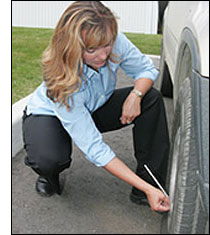
Flat tires make your engine work harder. Pushing all that dead floppy tire weight around is like driving in sand. Check your tire pressures once per month to ensure that they meet the recommended PSI rating. It’s also not a bad idea to overinflate those tires slightly. 5 PSI is plenty. Properly inflated tires also last longer as the tread wears evenly.

  • Purge your car of un-needed things, less stuff = less weight

We all have useless stuff rolling around in our trunks or under our seats. Get rid of that stuff, it’s robbing your fuel to weight ratio. When in doubt, pitch that shit.

  • Use fuel additives designed for your engine quarterly

Many auto companies sell products that are designed to clean and improve the performance of our engines. They do everything from cleaning fuel injectors to re-sealing piston rings. Some of these products don’t do a thing though. So ask your local car parts store worker what they recommend for your auto. Find what you think is right for you and throw a bottle of it in your tank at every oil change or every time the seasons change (quarterly).

  • Change your oil regularly or as recommended

This should be a given. Clean oil means less friction in your engine which equals better performance and fuel economy. Do it as often as the manufacturer recommends. Not only will your engine last longer and require less repairs, but all that horsepower will thank you. You may also think of switching to a synthetic type oil that improves lubrication and lasts longer.

Efficient Mototring: Part 4

Dont Drive Like an A-Hole
  • Accelerate Slowly

Where’s the fire muchacho? Rocketing through an intersection as soon as that green light hits is one of the least efficient things you can do as a motorist. RPM ratios apply here too. Getting your vehicle to red-line before it shifts might be fun, but think of all that wasted fuel virtually spraying right out the tailpipe.

  • Keep a Safe Following Distance

Following the advice they gave you in drivers’ ed. doesn’t just apply to safety. Maintaining a reasonable buffer between you and the car ahead of you can alleviate a lot of unneeded braking and accelerating. If you feel you’re in a potentially dangerous or awkward motoring situation do your best to get out of it or let everyone else get out of the way.

  • Remain Aware of the Things Around You

Keep a mental note of what is around you. Where the road is going, where traffic is coming from, where it is likely to go, and what vehicles are surrounding you. Try to memorize the color and types of vehicles traveling with you. It will be much easier to make that split second decision to change lanes and avoid slamming on the brakes for the car that needs to make an emergency turn.

  • Stay Calm and Courteous

Remaining in a level-headed state of mind will make all these tips a lot easier to follow. A clean car means a more serene driving environment. A well running motor equals less stress. And a fatter wallet is a nice piece of solace in an ever-expensive world. Staying calm allows you to make better decisions and to do it quickly. Allowing other motorists a courtesy now and then, makes you feel that much more generous, and at peace on the road. It can be difficult to curb your anger when someone else makes a bone-headed move, so I like to poke harmless fun at them as much as possible. Comment on the color of the car they’re driving: “That’s a nice purple truck, grandpa.” Create an acronym from their license plate: “[BMW 1431]. Broke Man-Whore’s last trick paid $14.31. Had to make 69 cents change” (That’s my actual license plate by the way. And I don’t drive a BMW) Stay comfortable, play soothing music, do what you have to do to stay sane in the slow lane.


All this boils down to one piece of advice: Keep Moving. Saving that positive momentum saves you gas.

Wednesday, March 12, 2008

Effective Cornering: Making Each Turn Work For You.


I've developed something I like to call Effective Cornering. It's basically a maneuver in which you round a corner at the highest comfortable speed in order to reduce braking while entering the corner, maintain momentum, and reduce acceleration after exiting the corner. It typically only works with right-hand turns and requires being familiar enough with your vehicle's handling characteristics along with traffic and road conditions. Race-car drivers employ this technique to maintain high speeds. But you can use it to save fuel and improve brake life.
Here's how it works:
When entering a traffic free corner there are five things your brain needs to asses.
  • Pavement & traffic condition: This will give you an immediate feeling of how safe a high speed approach will be for you, your vehicle, and everything around you. Therefore how much you should brake to achieve that speed.
  • Angle of corner: The sharpness of the corner will tell you how fast you should approach and how wide you will want to sweep before entering. Most traffic lanes are wider than you think, and if the vehicle's tires kiss that yellow line you're doing great. Most other motorists wont even notice.
  • Approach: Becoming comfortable with the angle of the corner will tell you where you should position your car when you begin the turn. Swing wide and visualize the widest possible curved line that will position you for the next part of the turn. This is also where you should have your speed set, letting off the brake.
  • Apex: The apex is a term used is astrology, geometry, dentistry and a million other areas of study. But it is commonly used to mean "the outermost tip." The apex is the outermost point of the traffic corner, but it will be the point of your turn closest to the inside of the corner. After making your approach try to position your right rear tire just to the outside of this point, and prepare for your grand exit.
  • Exit: Visualize the point on the road that you would like to end up at, and while swinging your vehicle wide, create a graceful curve to that point. It's best to think of your exit as a mirror image of your approach with the pivot being the apex.
Done properly, this maneuver will seem like one seamless, graceful turn and shouldn't look like a careless driving violation. Practice your approach, apex positioning and exit at low speeds first, then slowly increase speed until it's a comfortable maneuver. if you hear your tires chirping you've gone too far. Lower your speed and try again.
I will in no way assume responsibility for traffic fines, or damage to property.

~abC